
Outlander Filming Locations You Can Actually Visit
Doune Castle: Castle Leoch, Home of the Mackenzies (On Screen, Anyway)
I’ll confess it proudly: I’m a full-fledged Outlander fan. The kind who has opinions about 18th-century knitwear and occasionally gives a suspicious side-eye to any stone that looks even remotely circle-shaped. And lucky for you (and honestly, lucky for me), Scotland is absolutely bursting with real filming locations where Claire, Jamie, and the entire chaos-ridden cast left their mark.
But here’s the beauty, these places aren’t just movie props. They’re dripping with real Scottish history. The show sometimes sticks to the facts, sometimes wanders off with artistic licence flapping in the wind, and sometimes goes, “Aye, that’ll do.” But it all blends together beautifully when you're standing in the middle of it.
Let’s wander through Outlander’s world, equal parts fiction, truth, and pure Scottish drama.
Outlander gives us the emotional build-up to the Battle of Culloden, the tension, the heartbreak, the impossible choices, but standing on the actual battlefield adds a whole other layer of depth that the show simply can’t replicate. This is where fiction quietly steps aside and lets history take the lead.
The first thing you notice is the silence. Not an uncomfortable silence, a heavy, respectful one. Even on a breezy day (and trust me, it’s always breezy), there’s a stillness here that feels older than you are, older than Jamie Fraser, older than the stories themselves. It’s the kind of hush that makes you instinctively lower your voice, as if the moor is listening.
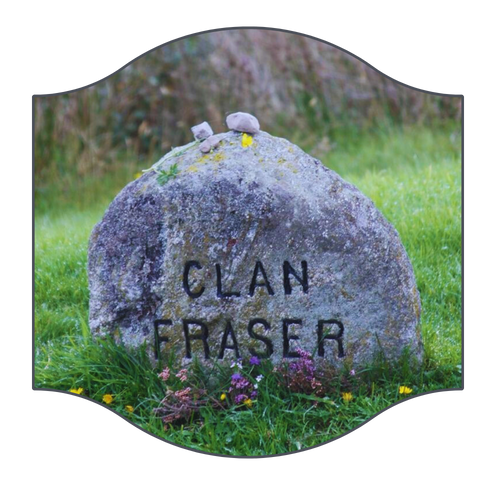
As you walk the paths, you’ll see the clan stones, simple markers noting where entire Highland families fought and fell in mere minutes. Fraser, MacGillivray, Cameron, MacIntosh… names that carry centuries of pride and heartbreak. Outlander dramatises their struggle beautifully, but being here, with the wind curling through the grass and the heather brushing your ankles, you suddenly understand the scale of it. The bravery. The tragedy. The utter devastation.
If you come here as an Outlander fan, you’ll recognise the emotional weight immediately.
If you come as someone curious about Scottish history, you’ll leave changed.
And if you come as both? Well… bring tissues. A few.
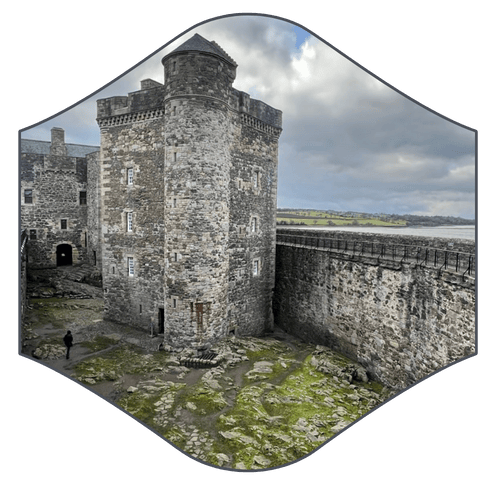
Blackness Castle: Fort William (Trauma Central)
And Now… The Big One. The Crown Jewel. The Holy Grail of Fan Pilgrimages...
LALLYBROCH! The Fraser homestead.
The emotional equivalent of a weighted blanket for Outlander fans.
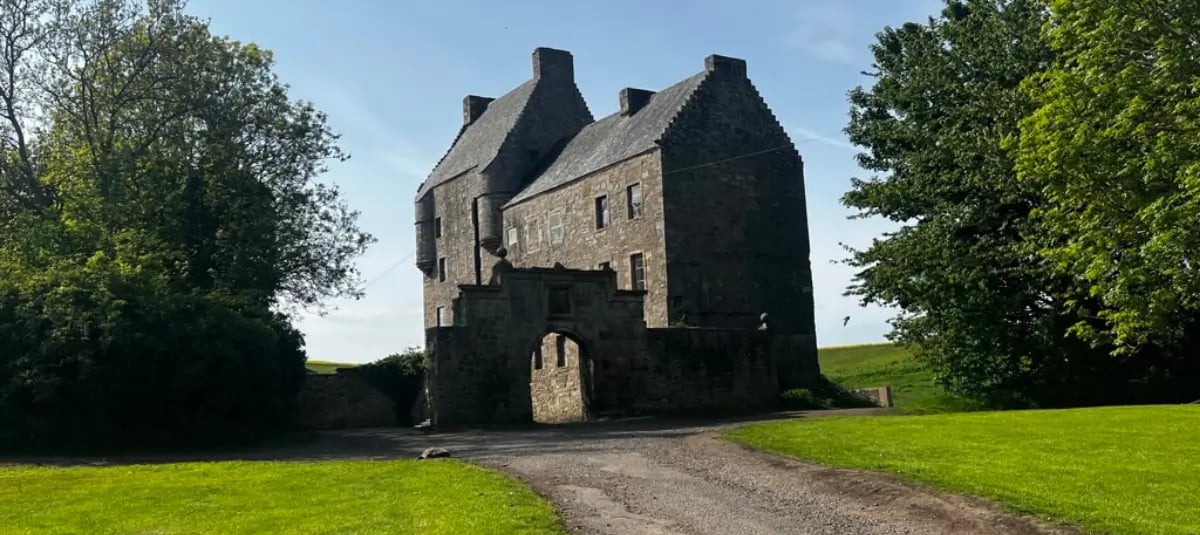
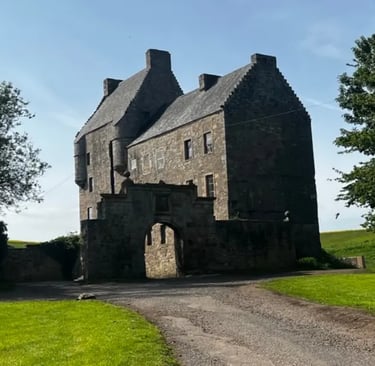
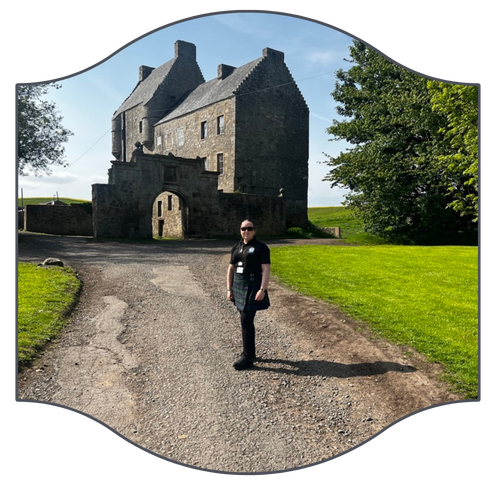
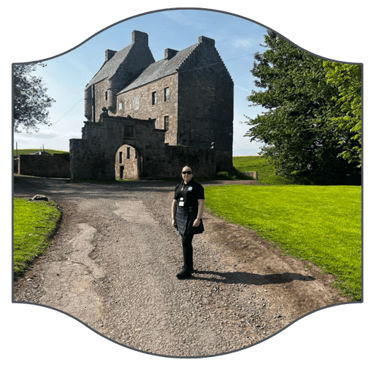
Midhope Castle is the real-life exterior used for Lallybroch, and approaching it is a full-body experience. Even I, a professional, composed, definitely mature person, have been known to whisper, “We’re home, Sassenach,” under my breath while absolutely no one asks me to.
Now, reality check: it’s a ruin. A beautiful, stoic, soulful ruin… but still a ruin. You can’t go inside. You can’t climb the stairs. You shouldn’t try to reenact Claire and Jamie’s more passionate moments because someone will have a camera.
But standing in that archway, looking into that courtyard, feeling the TV and real history blur together for just a second... That's the magic! That’s the moment every fan comes for.
And yes, even I still get a wee flutter in the chest every single time.
Midhope Castle: Lallybroch (Brace Yourself, Sassenach)
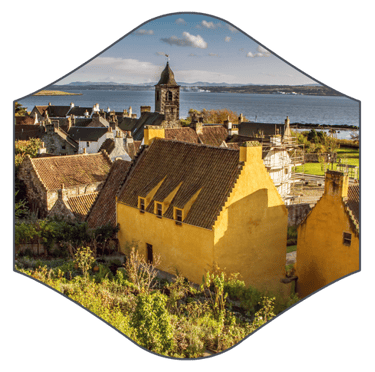
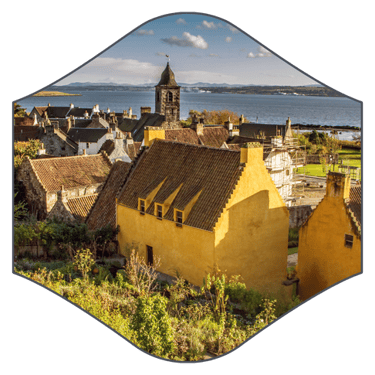
Culross is a time capsule wrapped in a film set and sprinkled with 17th-century fairy dust. When Outlander needed a village that feels properly old, like “so old your ancestors would recognise it” old, they came here.
It plays Cranesmuir, pops up as bits of Lallybroch, and moonlights as multiple other villages because, frankly, it looks that authentic. The cobbled streets could twist an ankle at twenty paces, and the houses are painted in colours that say, “I survived the 1600s, dear, what have you done today?”
Culross Palace’s ochre courtyard becomes Balriggan in the show, where Claire tends to locals with nothing but herbs, trauma, and womanly competence. In real life, the palace belonged to wealthy merchants who built coal mines stretching under the sea. To be fair, that’s exactly the sort of energy I’d expect from a town this dramatic.
If you want to feel like you’ve toddled straight through a wormhole, this is your place.
Culross: Cranesmuir, Lallybroch Corners, and Everything in Between
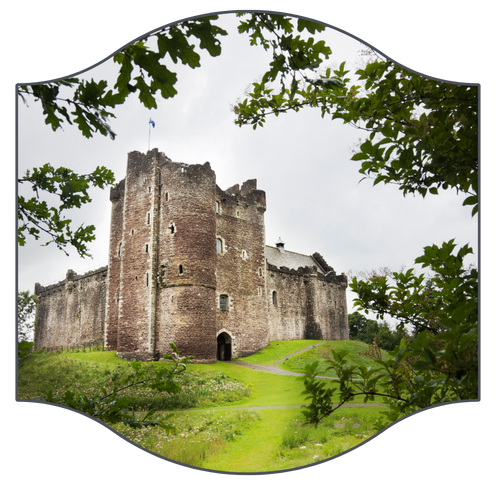
If a castle could win “Most Frequently Recognised by Strangers,” Doune Castle would sweep the awards. Outlander fans call it Castle Leoch, Monty Python fans yell, “Bring out your dead!”, and Game of Thrones fans quietly whisper, “Winterfell pilot episode…”
It’s the Beyoncé of castles; everyone thinks it belongs to them.
On the show, Doune is home to the Mackenzies: political masterminds, family feuders, and pioneers of the long, knowing stare. In reality, the castle belonged to the Duke of Albany, a man who practically ran medieval Scotland without ever being crowned king. Power move, that.
Walk through the courtyard, and it's almost impossible not to hear Mrs Fitz fussing at someone or imagine Claire getting dragged into yet another moment of accidental diplomacy. The place looks incredibly close to what you see on TV, no CGI fakery needed. Just old stone, Scottish weather, and centuries of attitude.
If you want to explore some of these Outlander filming locations, the real ones, the iconic ones, and the ones with great stories, I do happen to run an Outlander Day Tour that brings the show and the history together. Filled with laughs, tales, and the occasional “Jamie would’ve stood right there,” it’s a perfect day out for fans.
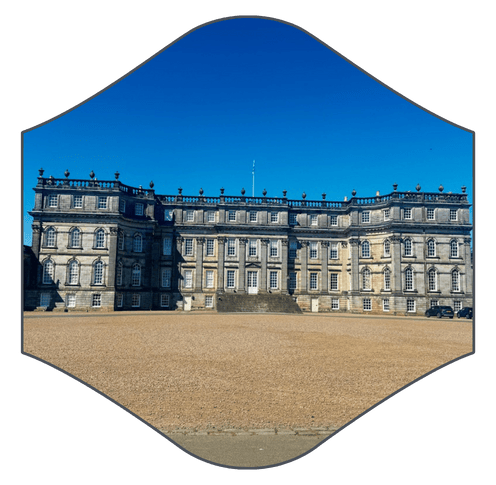
If Outlander had a “Most Dramatic Overachiever” award, Hopetoun House would win it in every season, accept the trophy, and still demand more screen time.
This grand estate near South Queensferry doesn’t just appear in the show, it turns up in multiple disguises like it’s on some 18th-century witness protection programme. It plays the Duke of Sandringham’s estate (a perfect match for his over-the-top personality), slips into various street scenes, grand interiors, and mysterious corridors, and generally pops up so often that once you recognise it, you’ll start yelling, “There it is again!” at the screen like a particular kind of maniac. With its sweeping staircases, elegant rooms, and hidden corners, it’s basically Outlander’s favourite costume-change location.
Historically, it’s the ancestral home of the Hope family, the same lot connected to Midhope Castle, our beloved Lallybroch, which makes it feel nicely poetic that both their houses ended up sharing the spotlight. Hopetoun isn’t just a filming location; it’s a full-blown character with range.
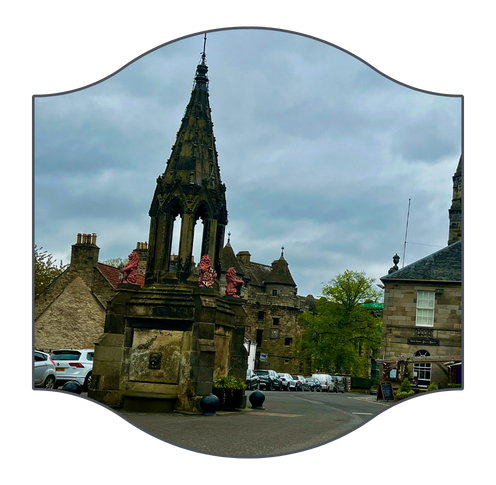
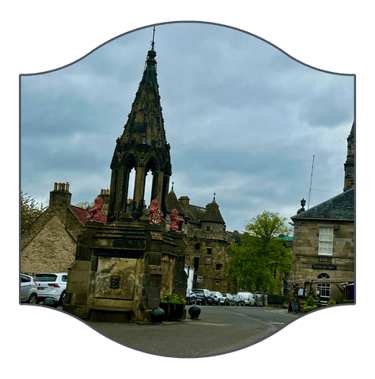
Falkland – “Inverness,” But Without the Crowds
Think of Falkland as Inverness’s glamorous understudy, always ready, always picture-perfect, and significantly closer to civilisation. When the show tosses Claire and Frank into 1940s Inverness, it’s actually Falkland in Fife doing all the heavy lifting.
The streets are cosy, the buildings charming, and the window where Claire spots Jamie’s ghost is exactly as dramatic in real life. It’s basically the Scottish version of “Romeo beneath the balcony,” just with more knitwear.
Historically, Falkland was a royal playground. The palace here is where Mary Queen of Scots knocked a ball about on what we’d now call a tennis court. And honestly, if Outlander ever needs a spin-off, “Mary Queen of Courts: The Tennis Years” is one I’d absolutely watch.
Every corner feels cinematic. Every doorway looks like it came with its own lighting director. And yes, people really do stand in the square reenacting Claire’s confused 1940s arrival. (No judgement. We’ve all done it!)
If you find yourself shivering before you’ve even stepped inside, congratulations, you’ve arrived at Blackness Castle, better known to fans as Fort William, where Black Jack Randall perfected the art of being the worst dinner guest in Scottish history.
This place is shaped like a ship, perched on the edge of the Forth, and has the exact emotional vibe of “someone is about to make a questionable choice.”
Historically, it was a royal stronghold, then a prison, then a munitions depot because apparently its stone walls were designed for maximum gloom and minimum comfort. Perfect for Outlander’s most gut-twisting scenes.
You can almost hear the clatter of boots on stone and Claire muttering, “Oh for heaven’s sake, again?” as Jamie heroically charges into yet another disaster.
Culloden Battlefield: Where Outlander Meets History Head-On
Hopetoun House: The Shape-Shifting Diva of Outlander
Fancy Visiting These Locations?
(Tiny Hint. Minuscule. Practically Invisible.)
Get In Touch
info@thescottishtourguide.com
+44 (0)7769691551
© 2025 The Scottish Tour Guide